


Multifamily in Today’s Economy: Doomsday or Opportunity?
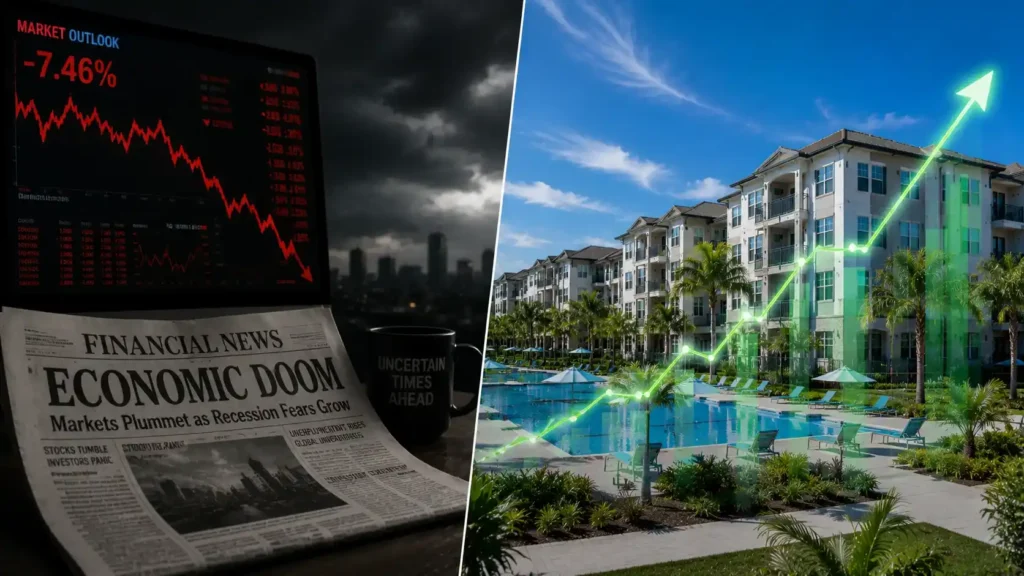
Multifamily real estate market assets are frequently mischaracterized by the financial media as teetering on the edge of a collapse, but the truth is that today’s economic environment presents a generational opportunity for accredited investors. Over the past year, a pervasive narrative of “doomsday” has swept across the investment landscape. Headlines warn of an impending real estate market crash, soaring interest rates, and a looming recession. This fear-mongering has paralyzed retail investors, causing them to flock to low-yielding cash equivalents and miss out on the most resilient wealth-building vehicle available today.
The reality is that the multifamily real estate market is fundamentally structurally sound. The current economic friction—inflation, elevated borrowing costs, and tight capital markets—is not a death sentence for real estate; it is a powerful filter that eliminates amateur operators and creates massive discounts for well-capitalized institutional buyers. When the public is panicking, the most lucrative recession-proof investments are quietly being acquired by those who understand underlying demographic data and housing fundamentals.
At Countrywide Capital Partners, our 20+ years of institutional experience and our track record of restructuring over $1B in real estate debt have given us a frontline view of market realities. We do not react to headlines; we rely on empirical data. In this comprehensive guide, we will dissect the six proven truths about the multifamily real estate market, proving why today’s economy is not a doomsday scenario, but rather the greatest opportunity of the decade to secure passive real estate income and build winning returns.
Truth 1: The Irrational Fear of a Real Estate Market Crash
The first truth to understand is that the fear of an impending real estate market crash is entirely irrational when you examine the structural mechanics of today’s housing sector. The doomsday narrative relentlessly draws inaccurate parallels between the current economic climate and the Great Recession of 2008. However, the two environments could not be more different.
The 2008 crash was triggered by a systemic banking failure fueled by toxic, zero-down, adjustable-rate subprime mortgages. When the teaser rates expired, millions of unqualified homeowners defaulted, flooding the market with distressed inventory and crashing property values overnight. Today, lending standards are incredibly stringent. Institutional lenders require massive down payments, strict debt-service coverage ratios (DSCR), and heavily verified income.
Furthermore, the majority of American homeowners are locked into 30-year fixed-rate mortgages with historically low interest rates (many below 4%). There is no mechanical trigger for a mass foreclosure wave because the average homeowner’s monthly housing payment is highly affordable. To verify the stark contrast in household balance sheets, you can analyze the Federal Reserve’s Financial Stability Report, which highlights the immense equity currently held by American households. Because the single-family housing market is effectively frozen—homeowners refuse to sell their low-rate mortgages—potential buyers are forced to remain in the rental pool. This structural shift funnels an already massive supply-demand imbalance directly into the multifamily real estate market, preventing a crash and ensuring stable occupancy rates.
Truth 2: Surging Multifamily Housing Demand is Unstoppable
The second truth driving the multifamily real estate market is the sheer volume of demographic tailwinds. The primary renting cohort—comprising millennials and Generation Z—is larger than any previous generation in US history. This demographic certainty guarantees that multifamily housing demand will remain robust for the next decade.
Millennials, the largest generation in the workforce, are now in their prime household-forming years (ages 25 to 40). Historically, this is the age when people buy their first homes. However, because of skyrocketing home prices, elevated mortgage rates, and massive student loan debt, millions of millennials are permanently delaying homeownership and choosing to rent Class A apartment complexes instead.
Simultaneously, Generation Z is entering the rental market in droves, filling Class B and C properties. Furthermore, Baby Boomers are downsizing and opting for the maintenance-free, amenity-rich lifestyle that modern multifamily communities provide. This convergence of generations creates record-breaking demand. According to comprehensive research from the Harvard Joint Center for Housing Studies, the US is short roughly 3.8 to 5.5 million housing units. This chronic underbuilding means you simply cannot have a housing crash when there is a national shortage of places for people to live. This supply-demand imbalance acts as an impenetrable floor for multifamily valuations.
Truth 3: The Ultimate Inflation Hedge Real Estate
The third truth is that multifamily real estate is the ultimate inflation hedge real estate. Inflation is the silent thief of wealth, eroding the purchasing power of cash and fixed-income investments like bonds. Real estate, conversely, is historically one of the most effective tools for combating inflation, and multifamily assets are the gold standard.
There are two primary mechanisms through which the multifamily real estate market acts as an inflation hedge. First, real estate values and replacement costs rise with inflation. The cost of lumber, steel, labor, and land all increase, making existing properties inherently more valuable. Second, and more importantly, rents can be adjusted. Unlike a commercial tenant locked into a 10-year lease, multifamily leases typically turn over every 12 months. This allows owners to reset rents to current market rates, keeping pace with or even outpacing inflation.
Furthermore, inflation actively destroys debt. If you hold a fixed-rate mortgage on an apartment complex, your monthly principal and interest payment remains static for decades. As inflation drives up the value of the property and the amount of rent you collect, you are paying back the loan with dollars that are worth less than the dollars you originally borrowed. This dual benefit of rising income and depreciating debt is what makes real estate a necessity for high-net-worth individuals looking to protect their portfolios. For a deeper understanding of how these assets function as a shield, you can review this comprehensive guide on inflation hedges from Investopedia.
Truth 4: Recession-Proof Investments Require Institutional Discipline
The fourth truth focuses on how to execute real estate investment strategies in a volatile economy. The current environment has eliminated the era of cheap money, where sloppy underwriting was bailed out by continually falling interest rates. Today, recession-proof investments require absolute institutional discipline.
Institutional underwriting requires stress-testing every assumption. When evaluating a multifamily real estate market acquisition, investors must model worst-case scenarios. What happens if interest rates rise another 100 basis points? What if vacancy spikes by 5%? What if insurance premiums, which have been volatile in certain markets, increase by 20%? If a deal cannot generate a positive cash-on-cash return under these stressed conditions, it must be passed over.
Furthermore, the structure of the capital stack is critical. Securing long-term, fixed-rate agency debt (Fannie Mae or Freddie Mac) is the safest way to insulate a property from interest rate volatility. For value-add projects requiring heavy renovations, utilizing flexible bridge debt can be effective, but only if the investor has a clear, executable exit strategy to refinance into permanent debt upon stabilization.
At Countrywide Capital Partners, we provide tailored real estate financing options that allow developers and operators to execute their business plans without taking on unnecessary balance sheet risk. Our disciplined underwriting ensures that every dollar deployed is protected, allowing our partners to navigate economic challenges with absolute confidence.
Truth 5: Capitalizing Through Real Estate Syndication
The fifth truth addresses how accredited investors can actually access these institutional-grade assets. Buying a single 10-unit apartment building directly is incredibly risky and operationally inefficient. If one tenant loses their job and stops paying rent, your cash flow takes a massive hit. Furthermore, managing a small portfolio is rarely a passive experience.
To achieve winning returns, accredited investors must leverage the power of scale through real estate syndication and private real estate funds. By pooling capital with other accredited individuals, investors can purchase 200-unit or 300-unit institutional-grade apartment complexes. This scale provides massive operational efficiencies. The cost to manage a 300-unit building per door is a fraction of the cost to manage a 10-unit building.
Moreover, large-scale acquisitions provide access to institutional property management and the best agency debt pricing. Most importantly, investing as a Limited Partner in a private fund offers completely passive exposure to the multifamily real estate market. The sponsor handles the acquisition, financing, renovation, property management, and eventual disposition. The investor simply collects their quarterly or monthly distributions. This hands-off approach allows high-net-worth individuals to capture the inflation-hedging, wealth-building power of real estate without sacrificing their time or dealing with the operational headaches of being a landlord.
Truth 6: The Florida Real Estate Market Amplifies Opportunities
The final truth is that geographic selection amplifies these advantages exponentially. While the national multifamily real estate market is strong, selecting the right local market is the ultimate differentiator between a good return and a spectacular return. The Florida real estate market is currently the epicenter of multifamily growth, and for good reason.
Florida’s pro-business, zero-income-tax environment has triggered a massive corporate relocation trend. Financial firms, tech companies, and healthcare conglomerates are moving their headquarters to Miami, Tampa, and Orlando. This brings thousands of high-paying jobs, creating an influx of affluent renters who can afford premium monthly rents.
Furthermore, Florida’s population growth shows no signs of slowing. The state adds hundreds of thousands of new residents every year, far outpacing the rest of the country. This relentless population growth, combined with strict zoning laws that make it difficult to build new supply, guarantees that multifamily housing demand will remain intense for the foreseeable future.
At Countrywide Capital Partners, our deep local market specialization allows us to identify high-potential assets in these Florida markets before they become widely recognized. We leverage our local relationships, our 20+ years of institutional experience, and our integrated execution platform to source, structure, and execute deals that deliver exceptional risk-adjusted returns to our partners.
Separating Doomsday from Opportunity
The narrative that the economy is doomed and real estate is about to collapse is a fundamentally flawed perspective pushed by media outlets that profit from fear. The data clearly shows that the multifamily real estate market is built on a foundation of strict lending, massive housing demand, and structural shortages.
For accredited investors, this environment is the definition of opportunity. With less competition from retail investors who are paralyzed by fear, those who deploy capital into recession-proof investments today will secure assets at favorable prices and generate massive returns as the market inevitably stabilizes and grows.
By utilizing real estate as an inflation hedge, targeting high-growth states like Florida, and partnering with an experienced sponsor, you can turn today’s economic challenges into the foundation of your family’s generational wealth. At Countrywide Capital Partners, we offer distinct avenues for investors to capture this upside. Our CCG Income Fund focuses on stabilized, cash-flowing assets that provide regular, passive income regardless of stock market volatility. For investors seeking aggressive capital appreciation, our CCG Growth Fund targets value-add repositioning and ground-up development to force equity in high-demand markets.
Furthermore, when a developer has a prime acquisition in a high-growth Florida market but lacks the equity to close, our Capital Partnership program steps in. We provide the fund-backed equity, balance sheet strength, and institutional underwriting required to close the deal, aligning the capital stack for maximum profitability.
Frequently Asked Questions
Q: Is the multifamily real estate market going to crash? A: No. A crash requires a massive wave of forced sales (foreclosures). Because current lending standards are incredibly strict and homeowners have record equity, there is no catalyst for a widespread foreclosure crisis. Furthermore, the US faces a massive structural housing shortage, ensuring demand remains high.
Q: Why is multifamily considered a recession-proof investment? A: Multifamily provides a basic human necessity: shelter. During economic downturns, people may delay buying a home or downsize, but they continue to rent. This keeps occupancy rates stable and ensures consistent cash flow for investors, unlike retail or office space which depend on discretionary spending and corporate employment.
Q: How does inflation impact multifamily real estate? A: Inflation benefits multifamily real estate. It drives up the cost of new construction, making existing properties more valuable. It also allows landlords to increase rents annually to keep pace with rising costs. Additionally, fixed-rate debt is devalued during inflationary periods, increasing the investor’s equity.
Q: How can I invest in multifamily real estate without being a landlord? A: By investing as a Limited Partner in a private real estate fund or syndication. You provide the capital, and the sponsor (like Countrywide Capital Partners) handles all aspects of property management, tenant relations, and asset disposition. This allows you to earn passive real estate income without the operational headaches of direct ownership.
Ready to Seize the Opportunity?
Do not let doomsday headlines dictate your financial future. The multifamily real estate market is fundamentally strong, offering accredited investors a prime opportunity to build lasting wealth while the retail public runs for the exits. Partner with our team to explore premium, professionally managed real estate investment opportunities designed to deliver income, growth, and long-term value.
Building wealth. Strengthening communities. Your trusted partner in real estate growth and wealth creation.