


Multifamily Market: 4 Proven Truths to Beat a Housing Crash
Multifamily market assets today possess a structural resilience that makes them fundamentally stronger and more secure than they were during the Great Recession. Over the past year, financial media outlets have stoked intense fear among the American public, drawing dangerous parallels between current economic headwinds—such as persistent inflation and rising interest rates—and the catastrophic collapse of the 2008 housing crash. This pervasive fear has caused retail investors to flee the real estate sector, creating a once-in-a-generation opportunity for well-capitalized, accredited investors who rely on data rather than headlines.
The reality is that the foundation of today’s real estate landscape is vastly different from the toxic, over-leveraged environment that preceded the real estate recession of 2008. While the Great Recession was defined by subprime mortgages, mass foreclosures, and a catastrophic oversupply of housing, today’s environment is characterized by incredibly strict lending standards, a chronic structural housing shortage, and surging demographic demand.
Understanding these differences is not just an academic exercise; it is the key to deploying capital effectively. When you recognize the true strength of the current multifamily market, you can confidently pursue real estate investment strategies that generate passive income and build generational wealth, even amid economic uncertainty. In this comprehensive guide, we will dissect the four proven reasons why today’s multifamily housing demand makes this asset class truly unstoppable, even as fears of a housing market crash loom.
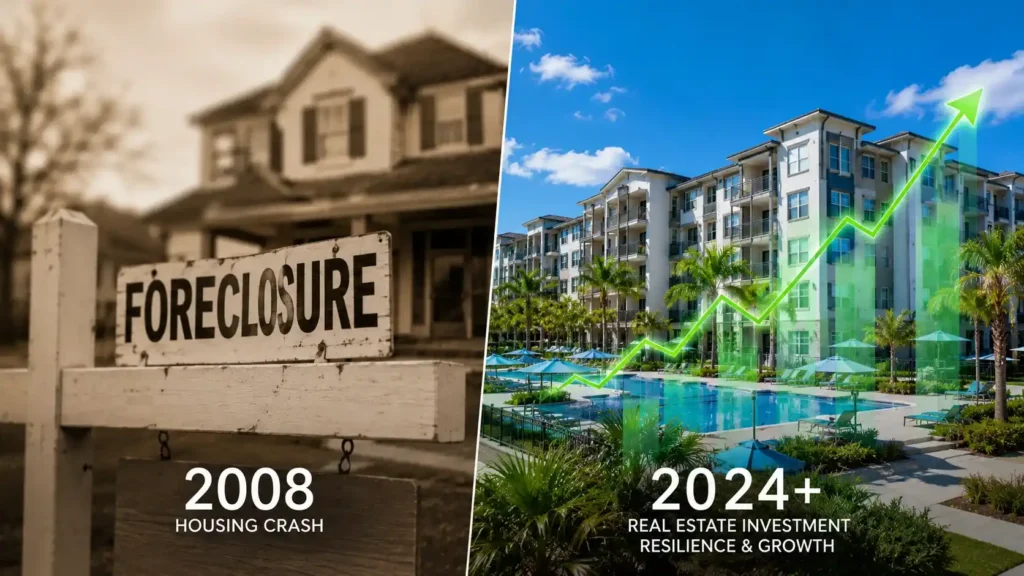
The Ghost of the 2008 Housing Crash vs. Today’s Reality
To understand why the multifamily market is poised for unprecedented success, we must first dispel the myth that a 2008-style housing market crash is repeating itself. The Great Recession was triggered by a systemic failure in the global financial markets. Banks issued zero-down, adjustable-rate mortgages to unqualified buyers, packaged those toxic loans into mortgage-backed securities, and sold them to institutional investors worldwide. When the teaser rates expired, millions of homeowners defaulted, flooding the market with distressed inventory and crashing property values overnight.
Today, the reality is the exact opposite. Lending standards are incredibly stringent. Institutional lenders require massive down payments, strict debt-service coverage ratios (DSCR), and heavily verified income. Furthermore, homeowners today are locked into 30-year fixed-rate mortgages with historically low interest rates (many below 4%). There is no mechanical trigger for a mass foreclosure wave because the average American homeowner’s monthly housing payment is highly affordable relative to their income.
Because the single-family housing market is effectively frozen—homeowners refuse to sell their low-rate mortgages—potential buyers are forced to remain in the rental pool. This structural shift funnels an already massive supply-demand imbalance directly into the multifamily market. To review the historical data and understand the stark contrast in household balance sheets, you can analyze the Federal Reserve’s Financial Stability Report, which highlights the immense equity currently held by American households, effectively preventing a repeat of the 2008 crash.
Reason 1: Bulletproof Lending Standards Prevent a Real Estate Recession
The first proven reason the multifamily market is unstoppable today is the absolute conservatism of the current capital stack. In 2008, commercial and residential real estate were propped up by speculative, high-leverage debt. Today, sweeping regulatory changes and institutional discipline have completely transformed how real estate is financed.
When a developer or sponsor acquires an apartment complex today, they cannot rely on toxic debt. Senior lenders require loan-to-value (LTV) ratios of 60% to 70% maximum, ensuring the sponsor has significant “skin in the game” (equity) at risk. Furthermore, lenders rigorously test the debt yield and DSCR to ensure the property’s net operating income (NOI) can comfortably cover debt service even if rents drop or operating expenses rise.
For accredited investors seeking opportunities, this means the downside risk is severely mitigated. The equity tranche is protected by a thick cushion of conservative, often fixed-rate debt. Even if property values experience a temporary valuation correction, the asset’s cash flow remains intact, allowing sponsors to hold the property through the economic cycle without facing margin calls or forced refinances. This financial conservatism is precisely what makes today’s real estate recession-resistant. At Countrywide Capital Partners, our 20+ years of institutional experience and our track record of restructuring over $1B in real estate debt mean we structure capital stacks designed to withstand severe economic shocks, protecting our partners’ capital above all else.
Reason 2: A Chronic Structural Housing Shortage
The second reason the multifamily market is fundamentally stronger today is the unprecedented, structural shortage of housing inventory. In the years leading up to 2008, homebuilders drastically overbuilt, constructing millions of speculative single-family homes and condos. When buyer demand dried up, the market was flooded with excess inventory, crashing prices across the country.
Today, the United States faces a deficit of millions of housing units. Following the 2008 crash, homebuilders drastically pulled back on construction for over a decade. Simultaneously, restrictive zoning laws, rising material costs, and NIMBY (Not In My Back Yard) policies made it incredibly difficult and expensive to entitle and build new apartment complexes.
This chronic underbuilding has resulted in a massive supply-demand imbalance that cannot be fixed overnight. According to comprehensive research from the Harvard Joint Center for Housing Studies, the US is short roughly 3.8 to 5.5 million housing units. This shortage acts as an impenetrable floor for multifamily market valuations. Even if a recession occurs, people will not become homeless; they will downsize, delay homeownership, or take on roommates, keeping apartment occupancy rates incredibly high. You simply cannot have a housing market crash when there is a national shortage of places for people to live.
Reason 3: Massive Demographic Tailwinds Fueling Multifamily Housing Demand
The third unstoppable force driving the multifamily market is the sheer volume of demographic tailwinds. The primary renting cohort—comprising millennials and Generation Z—is larger than any previous generation in US history.
Millennials, the largest generation in the workforce, are now in their prime household-forming years (ages 25 to 40). Historically, this is the age when people buy their first homes. However, because of skyrocketing home prices, elevated mortgage rates, and massive student loan debt, millions of millennials are permanently delaying homeownership and choosing to rent Class A apartment complexes instead.
Simultaneously, Generation Z is entering the rental market in droves, filling Class B and C properties. Furthermore, Baby Boomers are downsizing and opting for the maintenance-free, amenity-rich lifestyle that modern multifamily communities provide.
This convergence of generations creates record-breaking multifamily housing demand. The Florida real estate market exemplifies this trend perfectly. With no state income tax and a booming job market, Florida is absorbing hundreds of thousands of new residents annually. These transplants need housing immediately, and because they are priced out of the single-family market, they are renting luxury apartments. This demographic certainty ensures that cash flow in the multifamily market will remain robust for the next decade, making accurate housing market predictions easy: demand will only go up.
Reason 4: Institutionalization and Professional Management
The final reason today’s multifamily market is unstoppable is the professionalization of the asset class. In 2008, a significant portion of rental properties were owned by mom-and-pop investors who lacked the capital, systems, and expertise to weather a storm. When the market crashed, these amateur landlords defaulted, further depressing prices and exacerbating the crisis.
Today, the multifamily market is highly institutionalized. Large apartment complexes are owned by private equity firms, REITs, and sophisticated syndication platforms managed by professional real estate capital partners. These institutions employ vertically integrated platforms that handle acquisitions, construction, property management, and asset management with surgical precision.
This institutionalization brings unprecedented stability. Professional managers utilize advanced data analytics to optimize rent pricing, meticulously screen tenants to minimize default risk, and proactively maintain properties to preserve asset value. They also have access to deep capital reserves, allowing them to fund unexpected capital expenditures without resorting to distressed sales.
By partnering with an institutional sponsor through a Capital Partnership, accredited investors gain access to this level of professional execution. You are no longer relying on a local property manager; you are relying on a 20-year institutional track record that knows how to navigate complex market cycles and deliver risk-adjusted returns regardless of the economic climate.
The Power of Recession-Resistant Real Estate
When you combine bulletproof lending, a structural housing shortage, demographic tailwinds, and institutional management, you get the definition of recession-resistant real estate. This is the core reason why doom-and-gloom housing market predictions of a 2008-style crash are fundamentally flawed.
During an economic downturn, certain asset classes suffer immensely. Retail depends on consumer discretionary spending. Office space depends on corporate employment levels. The multifamily market, however, provides a basic human necessity: shelter.
If a recession hits and job losses mount, consumers will immediately cut back on vacations, dining out, and new cars, but they will not stop paying rent. They may downsize from a luxury home to a luxury apartment, or take on a roommate, but the rental unit remains occupied and generating revenue. This defensive quality is why high-net-worth individuals allocate heavily to real estate syndication. It provides a reliable stream of passive real estate income that is decoupled from the daily volatility of the stock market.
How Accredited Investors Can Capitalize on the Current Market
Understanding the strength of the multifamily market is only the first step. The real question is: how do accredited investors capitalize on this environment to build generational wealth while the retail public runs for the hills?
The most effective approach is to allocate capital into private real estate funds that target high-growth geographic nodes. Rather than trying to buy and manage a single apartment building themselves—a process fraught with operational risk and inefficiency—accredited investors can pool their capital with a professional sponsor.
At Countrywide Capital Partners, we offer distinct avenues for investors to capture the upside of the multifamily market. For those seeking regular, predictable cash flow, our CCG Income Fund focuses on stabilized, cash-flowing assets in prime Florida markets. These assets are already operating at peak efficiency, generating monthly distributions that act as a powerful inflation hedge.
For investors seeking aggressive capital appreciation, our CCG Growth Fund targets value-add repositioning and ground-up development. We identify underperforming assets in the path of progress, utilize our institutional capital to renovate the units and amenities, and force massive equity creation through increased rental rates.
By investing alongside us, you bypass the operational headaches of property management while capturing the institutional-grade returns that are typically reserved for large private equity firms. We employ disciplined underwriting, stress-testing every assumption to ensure our investments perform regardless of where we are in the economic cycle. Furthermore, we provide flexible real estate financing options for developers who need strategic capital to execute their business plans in this resilient market.
Why the Florida Real Estate Market Amplifies These Advantages
While the national multifamily market is strong, selecting the right local market amplifies these advantages exponentially. The Florida real estate market is currently the epicenter of multifamily growth, and for good reason.
Florida’s pro-business, zero-income-tax environment has triggered a massive corporate relocation trend. Financial firms, tech companies, and healthcare conglomerates are moving their headquarters to Miami, Tampa, and Orlando. This brings thousands of high-paying jobs, creating an influx of affluent renters who can afford premium monthly rents.
Furthermore, Florida’s population growth shows no signs of slowing. The state adds hundreds of thousands of new residents every year, far outpacing the rest of the country. This relentless population growth, combined with strict zoning laws that make it difficult to build new supply, guarantees that demand for multifamily properties will remain intense for the foreseeable future.
At Countrywide Capital Partners, our deep local market specialization allows us to identify high-potential assets in these Florida markets before they become widely recognized. We leverage our local relationships, our 20+ years of institutional experience, and our integrated execution platform to source, structure, and execute deals that deliver exceptional risk-adjusted returns to our partners.
Overcoming the Fear of Economic Cycles
A major impediment to wealth building is the fear of economic cycles. The media perpetuates a narrative that recessions are times to hoard cash and wait for the sky to fall. However, historical data shows that the multifamily market consistently outperforms other asset classes during recessions.
During the 2008 financial crisis, while single-family home values plummeted and equity markets crashed, multifamily occupancy rates remained relatively stable. Rentership rates actually increased as millions of Americans lost their homes to foreclosure and were forced back into the rental pool.
The key to overcoming fear is data-driven underwriting. When you acquire a multifamily asset at a reasonable basis, with strong in-place cash flow and conservative, fixed-rate debt, you are insulated from short-term economic fluctuations. You do not need to sell the asset; you simply hold it, collect the rent, and wait for the market to recover. This ability to hold through downturns is what separates successful institutional investors from panic-selling retail investors.
The Final Verdict on Housing Market Predictions
The data is clear. The fears of an impending housing market crash are entirely unfounded when you examine the structural realities of today’s housing sector. Strict lending standards, massive equity cushions, and a chronic underbuilding of housing units ensure that a 2008-style collapse is virtually impossible.
For accredited investors, this means the current environment is a buyer’s market. With less competition from retail investors who are paralyzed by fear, those who deploy capital into recession-resistant real estate today will secure assets at favorable prices and generate massive returns as the market inevitably stabilizes and grows.
The multifamily market is not just alive; it is fundamentally unstoppable. By focusing on multifamily properties in high-growth markets like Florida, and by partnering with an institutional sponsor who employs disciplined underwriting and vertical integration, you can turn today’s economic challenges into the foundation of your family’s generational wealth.
Frequently Asked Questions
Q: Is the multifamily market going to crash like it did in 2008? A: No. The 2008 crash was caused by toxic subprime mortgages and an oversupply of housing. Today, lending standards are incredibly strict, homeowners have record equity, and the US faces a massive structural housing shortage. These factors make a crash highly improbable.
Q: Why is multifamily considered recession-resistant real estate? A: Multifamily provides a basic necessity: shelter. During economic downturns, people may delay buying a home or downsize, but they continue to rent. This keeps occupancy rates stable and ensures consistent cash flow for investors.
Q: How do high interest rates affect the multifamily market? A: High interest rates increase borrowing costs, which can temporarily compress property valuations. However, they also keep potential homebuyers in the rental pool, driving up multifamily housing demand. Sponsors can mitigate rate risk by securing long-term, fixed-rate agency debt.
Q: How can I invest in real estate without being a landlord? A: By investing as a Limited Partner in a private real estate syndication or fund. You provide the capital, and the sponsor handles the acquisition, financing, renovation, and property management. This allows you to earn passive real estate income without the operational headaches.
Ready to Capitalize on an Unstoppable Market?
Do not let fear-mongering and inaccurate housing market predictions keep you on the sidelines. The multifamily market is fundamentally stronger today than it has ever been, offering accredited investors a prime opportunity to build lasting wealth. Partner with our team to explore premium, professionally managed real estate investment opportunities designed to deliver income, growth, and long-term value.
Building wealth. Strengthening communities. Your trusted partner in real estate growth and wealth creation.