


Why Invest in Florida Multifamily Real Estate?
Invest in Florida real estate to secure a premier position in one of the most dynamic and lucrative markets in the United States. For accredited investors looking to deploy capital into tangible, cash-flowing assets, the Sunshine State presents an unparalleled convergence of demographic, economic, and regulatory tailwinds. While other states grapple with stagnant populations, high taxes, and deteriorating infrastructures, Florida is experiencing a historic boom that shows no signs of slowing down.
However, navigating this lucrative landscape requires institutional expertise. Simply buying any property in Florida is not a guaranteed recipe for success. The highest, most risk-adjusted returns are found in multifamily properties—assets that provide a basic human necessity (shelter) while benefiting from the state’s explosive population influx.
At Countrywide Capital Partners, our 20+ years of institutional experience and vertically integrated platform allow us to execute complex real estate investment strategies with surgical precision. In this comprehensive guide, we will explore the seven proven paths to profitable wealth through multifamily real estate in Florida, demonstrating why this market is the ultimate haven for accredited investor opportunities.
Path 1: Capitalizing on Unprecedented Population Growth in Florida
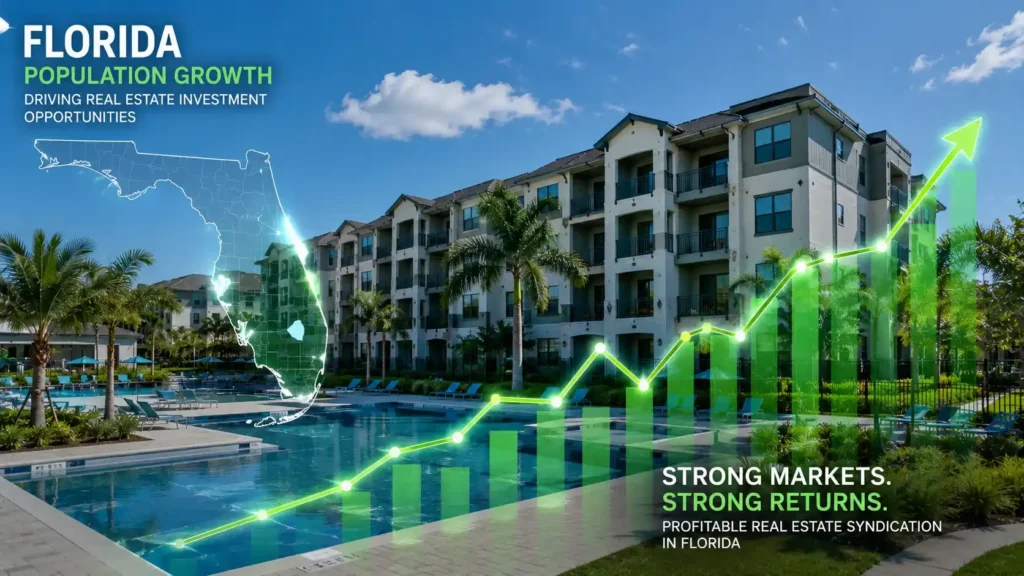
The foundational driver of the Florida housing market is the relentless, record-breaking population growth. For years, Florida has been the top destination for domestic migration in the United States. The state adds hundreds of thousands of new residents annually, driven primarily by Americans fleeing high-tax, heavily regulated states in the Northeast and California.
This massive influx of transplants is not a temporary trend; it is a structural shift in the American economy. The rise of remote work untethered high-earning professionals from expensive coastal cities, allowing them to seek locales with a lower cost of living and superior quality of life. According to macroeconomic data and U.S. Census Bureau statistics, Florida consistently leads the nation in net domestic migration.
For real estate investors, this demographic certainty translates directly into insatiable demand for housing. When hundreds of thousands of people move to a state every year, they need places to live immediately. This relentless population growth in Florida ensures that multifamily occupancy rates remain historically high, providing a rock-solid foundation for consistent passive real estate income.
Path 2: The Pro-Business and Zero Income Tax Advantage
The second path to profitability is understanding the macroeconomic policies that make Florida uniquely attractive compared to the rest of the country. Florida is one of only a handful of states that levies zero state income tax. This means residents keep more of their earned income, and businesses operate with a significantly lower tax burden.
This pro-business environment has triggered a massive corporate relocation trend. Major financial institutions, tech giants, and healthcare conglomerates have moved their national or regional headquarters to cities like Miami, Tampa, and Orlando. This influx of corporate capital brings thousands of high-paying jobs, creating a demographic of affluent renters who can comfortably afford premium monthly rents for Class A multifamily properties.
Furthermore, Florida’s legal and regulatory environment is highly favorable for landlords. The state strictly prohibits rent control, allowing property owners and real estate capital partners to adjust rents in real-time to keep pace with inflation and market demand. This alignment of pro-business policy, zero income tax, and landlord-friendly laws creates an impenetrable moat around your real estate investment strategies, protecting your cash flow from political interference.
Path 3: The Resilience of the Florida Housing Market
The third path involves recognizing the structural resilience of the Florida housing market against national economic headwinds. While the financial media constantly predicts a national real estate market crash, such doomsday scenarios fail to account for local supply-demand dynamics.
The United States as a whole faces a chronic, structural shortage of millions of housing units. This shortage is particularly acute in high-growth states like Florida. Following the 2008 Great Recession, homebuilders drastically pulled back on construction for over a decade. Simultaneously, restrictive zoning laws and rising material costs made it incredibly difficult and expensive to entitle and build new apartment complexes.
Because of this chronic underbuilding, you simply cannot have a housing crash in Florida when there is a severe shortage of places for people to live. Even if a national recession occurs, people will not become homeless; they will downsize, delay homeownership, or take on roommates, keeping multifamily occupancy rates incredibly high. This supply-demand imbalance acts as an impenetrable floor for valuations, making multifamily assets the ultimate recession-resistant real estate. To understand the depth of this national inventory shortage, you can review comprehensive research from the Harvard Joint Center for Housing Studies.
Path 4: Generating Massive Passive Real Estate Income Through Multifamily
The fourth path to wealth is shifting from speculative single-family investing to the institutional scale of multifamily properties. While buying a single condo or house might seem like an easy entry point, it is highly inefficient and fraught with concentrated risk. If a single-family tenant loses their job and stops paying rent, your cash flow drops to zero, and you must cover the mortgage out of pocket.
Multifamily real estate, conversely, relies on the power of scale. When you invest in a 200-unit apartment complex, the risk is distributed across hundreds of tenants. If two or three units become vacant, the remaining 197 units continue to generate revenue, ensuring your cash flow remains stable and uninterrupted.
Furthermore, the economies of scale in multifamily real estate drastically reduce operating expenses. The cost to manage a 200-unit building per door is a fraction of the cost to manage 200 individual single-family homes scattered across a county. This operational efficiency allows for higher net operating incomes (NOI), which directly translates into larger, more consistent passive real estate income for investors. By pooling capital through real estate syndication, accredited investors can access this institutional scale without the operational headaches of being a landlord. For a deeper understanding of these structures, you can review this comprehensive guide on real estate syndication from Investopedia.
Path 5: Forcing Equity in the Orlando Real Estate Market
The fifth path requires identifying specific, high-growth geographic nodes within the state. While Miami and Tampa often grab the headlines, the Orlando real estate market represents one of the most lucrative, under-the-radar opportunities for multifamily investors.
Orlando is no longer just a tourist destination; it is a booming, diversified metropolitan area. The region has aggressively diversified its economy, becoming a major hub for technology, healthcare, and advanced manufacturing. Furthermore, the Orlando area is home to the University of Central Florida, one of the largest universities in the country, providing a continuous pipeline of young professionals entering the rental market.
For accredited investors, the strategy in Orlando is value-add repositioning. By acquiring older, Class B or C apartment complexes in the path of progress, investors can utilize institutional capital to renovate the units, upgrade the amenities, and rebrand the property. This forced appreciation allows owners to raise rents to current market rates, instantly generating massive equity. At Countrywide Capital Partners, our CCG Growth Fund is specifically designed to execute these value-add strategies, capturing outsized returns for our partners by transforming underperforming assets in high-growth Florida markets.
Path 6: Leveraging Real Estate as an Inflation Hedge
The sixth path is utilizing Florida multifamily assets as the ultimate inflation hedge. Inflation is the silent thief of wealth, eroding the purchasing power of cash and fixed-income investments like bonds. Real estate, conversely, is historically one of the most effective tools for combating inflation.
There are two primary mechanisms through which the Florida multifamily market acts as an inflation hedge. First, real estate values and replacement costs rise with inflation. The cost of lumber, steel, labor, and land all increase, making existing, already-built properties inherently more valuable. Second, multifamily leases typically turn over every 12 months. This allows owners to reset rents to current market rates, keeping pace with or even outpacing inflation.
Furthermore, inflation actively destroys debt. If you hold a fixed-rate mortgage on an apartment complex, your monthly principal and interest payment remains static for decades. As inflation drives up the value of the property and the amount of rent you collect, you are paying back the loan with dollars that are worth less than the dollars you originally borrowed. This dual benefit of rising income and depreciating debt is what makes real estate a necessity for high-net-worth individuals looking to protect their portfolios.
Path 7: Partnering with Institutional Real Estate Capital Partners
The final, and perhaps most critical path, is selecting the right partner. The Florida real estate market is highly competitive. To consistently acquire institutional-grade assets at favorable prices, investors need a sponsor with deep local relationships, proprietary deal flow, and a vertically integrated execution platform.
This is where Countrywide Capital Partners provides an unmatched advantage. We do not just act as a capital provider; we act as your strategic real estate capital partners. When a developer identifies a prime multifamily acquisition but lacks the equity to close, our Capital Partnership program steps in. We provide the balance sheet strength, fund-backed equity, and institutional underwriting required to complete the capital stack.
We handle the heavy lifting: structuring the financing, overseeing the general contractor responsibilities during renovations, and implementing professional property management solutions to maximize operational efficiency. By aligning performance with purpose, we ensure that every dollar deployed is protected and positioned for aggressive growth.
For accredited investors seeking truly passive exposure to the Florida real estate market, our funds offer distinct avenues for success. Investors can choose to deploy capital alongside us, bypassing the operational headaches of direct ownership while capturing the institutional-grade returns that are typically reserved for large private equity firms. We also provide tailored real estate financing options for developers who need strategic capital to execute their business plans in this resilient market.
The Mechanics of a Profitable Real Estate Portfolio
Building a profitable real estate portfolio in Florida requires more than just capital; it requires a disciplined approach to underwriting and asset management. At Countrywide Capital Partners, our 20+ years of institutional experience and our track record of restructuring over $1B in real estate debt mean we structure capital stacks designed to withstand severe economic shocks.
We employ rigorous financial analysis, stress-testing every assumption to ensure our investments perform across various market cycles. We do not rely on speculative appreciation; we force equity through operational improvements and strategic renovations. By focusing on attainable housing and value-add repositioning, we create resilient assets that generate consistent cash flow regardless of where we are in the economic cycle.
Furthermore, we understand the critical importance of tax strategies in real estate investing. Real estate offers massive tax advantages, including the ability to deduct mortgage interest, depreciate the asset’s value, and defer capital gains through 1031 exchanges. We encourage all our investors to work closely with their CPAs to fully leverage these benefits, maximizing their after-tax returns. For official guidance on how these tax deferrals work, you and your financial team should review the IRS guidelines on like-kind exchanges.
Why the Time to Act is Now
The window of opportunity in the Florida real estate market is open, but it will not remain open indefinitely. The current economic climate, characterized by elevated interest rates and tight capital markets, has driven many retail investors to the sidelines. This reduction in competition has created a buyer’s market for well-capitalized institutional buyers.
Assets that were trading at inflated prices during the era of zero-percent interest rates are now available at highly rational, discounted valuations. By deploying capital today, accredited investors can lock in superior basis points and position themselves for massive capital appreciation when the interest rate cycle inevitably turns and capital markets loosen.
Furthermore, the demographic tailwinds driving population growth in Florida are accelerating. Every day, thousands of new residents arrive, intensifying the demand for housing. Delaying investment means missing out on months of passive real estate income and allowing competitors to capture the prime assets in the most sought-after markets.
Frequently Asked Questions
Q: Why is the Florida real estate market so popular among accredited investors? A: Florida offers a unique convergence of zero state income tax, massive population growth, a pro-business regulatory environment, and landlord-friendly laws. This creates an insatiable demand for housing, ensuring high occupancy rates and consistent cash flow for multifamily investors.
Q: What makes multifamily properties better than single-family homes for passive income? A: Multifamily properties offer economies of scale, significantly lowering the per-door cost of management and maintenance. They also distribute risk across multiple tenants; if one unit becomes vacant, the others continue generating revenue, ensuring stable cash flow.
Q: How can I invest in Florida multifamily real estate without being a landlord? A: By investing as a Limited Partner in a private real estate fund or syndication. You provide the capital, and the sponsor (like Countrywide Capital Partners) handles the acquisition, financing, renovation, and property management. This allows you to earn passive income without the operational headaches.
Q: Is the Florida real estate market immune to a national housing crash? A: While no market is entirely immune to macroeconomic shocks, Florida’s structural housing shortage, strict lending standards, and relentless population growth provide a massive cushion against price corrections. A 2008-style crash driven by oversupply and subprime mortgages is highly improbable in today’s market.
Ready to Capitalize on the Florida Real Estate Market?
Do not let the greatest wealth-building opportunity of this decade pass you by. Partner with our team to explore premium, professionally managed real estate investment opportunities designed to deliver income, growth, and long-term value. Whether you are looking to deploy capital into a diversified fund or need strategic sponsorship for a development project, Countrywide Capital Partners is here to help.
Building wealth. Strengthening communities. Your trusted partner in real estate growth and wealth creation.