


Rental Market: 7 Proven Truths For Profitable Wealth
Rental market dynamics have fundamentally shifted the landscape of American wealth creation, as the dream of homeownership is suffocated by the worst housing affordability crisis in modern history. For decades, the societal script dictated that buying a home was the ultimate milestone of financial success. However, the economic reality of 2024 has violently rewritten that script. With skyrocketing home prices and elevated mortgage rates, the cost of buying a home has become mathematically prohibitive for a massive segment of the population.
This structural shift has forced a historic transition from a homeownership society to a renter society. For accredited investors, this is not a societal tragedy; it is a generational wealth-building opportunity. When millions of potential homebuyers are priced out of the market, they are forced to remain in the rental pool, driving multifamily housing demand to record-breaking heights.
At Countrywide Capital Partners, our 20+ years of institutional experience and our track record of restructuring over $1B in real estate debt have given us a frontline view of these macroeconomic shifts. We do not follow the retail narrative; we follow the capital flows. In this comprehensive guide, we will explore why renting ranks supreme in today’s economy and detail the seven proven truths that make the rental market a highly profitable path to long-term wealth.
The Core of the Housing Affordability Crisis
To understand why the rental market is thriving, one must first understand the severity of the housing affordability crisis. The media often blames high interest rates for freezing the housing market, but the truth is much deeper. The crisis is a convergence of restricted supply, inflated demand, and a severe mathematical mismatch in the cost of buying a home.
In the years following the 2008 Great Recession, homebuilders drastically pulled back on construction for over a decade. Simultaneously, restrictive zoning laws and rising material costs made it incredibly difficult to entitle and build new housing. This created a chronic, structural shortage of millions of housing units. According to comprehensive research from the Harvard Joint Center for Housing Studies, the United States is short roughly 3.8 to 5.5 million housing units.
When interest rates spiked in 2023 and 2024, the affordability crisis reached a breaking point. The median home price, combined with a 7% mortgage rate, pushed the monthly cost of homeownership far beyond the reach of the median American household. The math is simple: when the cost of buying a home becomes unaffordable, demand shifts entirely to the rental market. This is not a temporary trend; it is a structural reset of how Americans live.
01- The Historic Cost Gap Between Renting and Owning
The first proven truth driving the rental market is the historic disparity between the cost of renting and the cost of owning. The disparity between renting and owning has widened to unprecedented levels, permanently altering the housing ecosystem.
According to data compiled from the Wall Street Journal, CBRE Research, CBRE Econometric Advisors, Freddie Mac, the U.S. Census Bureau, Realtor.com, and the FHFA, the mathematical burden of homeownership has become overwhelming. As of October, the median existing-home price hit $392,000, a record high. Meanwhile, mortgage rates have surged, rapidly shrinking the purchasing power of prospective homebuyers. For instance, a $2,000 monthly budget that once secured a home worth over $400,000 now caps out at just $295,000. Buyers face the dual challenge of higher costs and fewer options, as a severe housing shortage keeps prices elevated. (Note: This data assumes a 10% down payment and includes private mortgage insurance).
A 2023 CBRE study highlights that renting is now 52% cheaper than buying for new homebuyers, on average. In high-cost cities like Seattle, Austin, and parts of California, that gap widens to an astonishing 175% or more. Renters are paying an average of $2,184 per month, while new homeowners face an average monthly mortgage of $3,322. This represents the largest cost gap on record, based on a standard 30-year fixed mortgage with a 20% down payment, according to Bankrate.com.
When the financial cost of buying a home is more than double the cost of renting, the rational economic choice for millions of households is to rent. This mathematically guarantees a massive, sustained influx of tenants into the rental market.
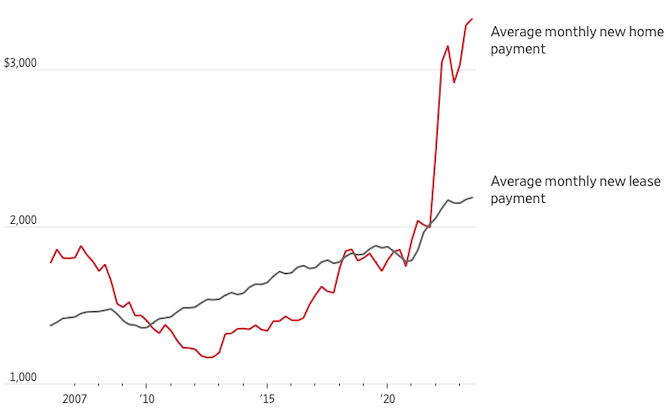
Graph Source: Wall Street Journal, CBRE Research, CBRE Econometric Advisors, Freddie Mac, U.S. Census Bureau, Realtor.com®, FHFA
Note: The data assumes a 10% down payment and includes private mortgage insurance.
The disparity between renting and owning has widened to historic levels. As of October, the median existing-home price hit $392,000, a record high. Meanwhile, mortgage rates have surged, shrinking purchasing power for homebuyers. For instance, a $2,000 monthly budget that once secured a home worth over $400,000 now caps out at just $295,000. Buyers face the dual challenge of higher costs and fewer options, as a severe housing shortage keeps prices elevated.
A 2023 CBRE study highlights that renting is now 52% cheaper than buying for new homebuyers, on average. In high-cost cities like Seattle, Austin, and parts of California, that gap widens to an astonishing 175% or more. Renters are paying $2,184 per month, while new homeowners face an average monthly mortgage of $3,322 — the largest cost gap on record.

Graph Source: Bankrate.com
Note: Based on a standard 30-year fixed mortgage, with a 20% down payment
02- First-Time Buyers Are Priced Out and Aging Out
The second truth examines the direct impact of the affordability crisis on first-time buyers. The dream of homeownership is being delayed indefinitely for a massive demographic segment.
Historically, 38% of buyers were purchasing their first home. However, according to data from the Wall Street Journal and the National Association of Realtors, that figure dropped to just 33% in 2023. The median age for first-time buyers has also risen, from 33 years old in 2021 to 35 today, reflecting the increasing challenges of entering the market.
This shift is fundamentally reshaping the landscape. With the financial burden of homeownership climbing, the demand for rentals—particularly multifamily properties—is surging. Renting offers a cost-effective alternative that aligns with current economic realities, pushing more people toward multifamily living. These are not transient, unreliable tenants; they are 35-year-old professionals with stable incomes who simply cannot afford a $400,000 mortgage. For accredited investors, this means a higher caliber of tenant, lower default rates, and incredibly stable passive real estate income.
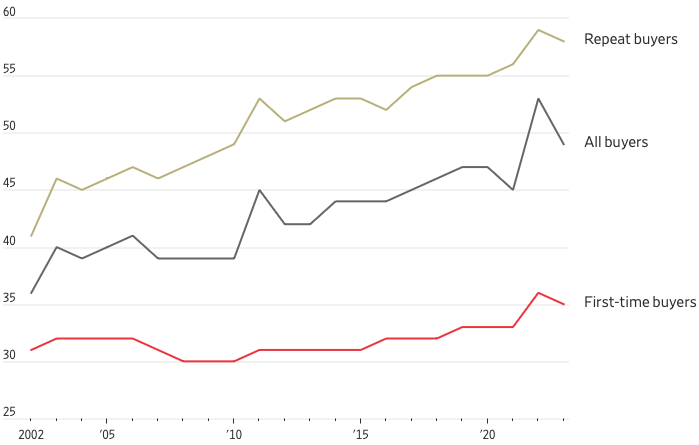
Source: Wall Street Journal, National Association of Realtors
03- The Lock-In Effect Freezes Homeownership
The third truth driving the rental market is the “lock-in effect.” During the post-pandemic era of zero-percent interest rates, millions of Americans refinanced their homes or purchased properties with 30-year fixed-rate mortgages between 2.5% and 4%. Today, those same homeowners are entirely unwilling to sell their homes and take on a 7% mortgage.
This psychological and financial lock-in effect has created a frozen single-family housing market. Inventory is at historic lows because nobody wants to give up their cheap debt. While this freezes the sales market, it directly fuels the rental market.
Potential homebuyers who are ready to form households, relocate for new jobs, or upgrade their living situations cannot find affordable homes to buy. Their only solution is to rent. This pent-up demand floods the multifamily housing sector, ensuring that apartment complexes maintain historically high occupancy rates. The lock-in effect is not just a footnote; it is a powerful macroeconomic force that guarantees a steady stream of high-quality tenants for institutional real estate investors.
04- Demographic Tsunami Floods the Rental Market
The fourth truth is that the rental market is being flooded by an unprecedented demographic tsunami. The primary renting cohort—comprising millennials and Generation Z—is the largest in US history.
Millennials, the largest generation in the workforce, are now firmly in their prime household-forming years. As established, the median age of a first-time homebuyer has now risen to 35. Millions of millennials are permanently delaying homeownership and choosing to rent Class A and B apartment complexes instead.
Simultaneously, Generation Z is entering the rental market in droves. Gen Z values flexibility, mobility, and amenity-rich living over the financial burden and maintenance headaches of homeownership. Furthermore, Baby Boomers are downsizing, seeking maintenance-free living, and moving to pro-business, zero-income-tax states. This convergence of generations creates record-breaking multifamily housing demand that will persist for the next decade, entirely independent of macroeconomic volatility.
05- Multifamily Housing Demand is Structural, Not Cyclical
The fifth truth dismantles the myth that the current strength of the rental market is a temporary byproduct of high interest rates. The reality is that multifamily housing demand is structural, not cyclical.
Even if the Federal Reserve were to slash interest rates tomorrow, the housing affordability crisis would not be resolved. The structural deficit of 3.8 to 5.5 million housing units cannot be built overnight. It takes years to entitle land, pull permits, and construct new apartment complexes.
Furthermore, even if rates dropped, home prices would immediately surge higher as pent-up demand flooded the buying market, once again pushing the cost of buying a home out of reach for the middle class. The United States is structurally becoming a nation of renters. This means that cash flow in the rental market is highly resilient, allowing investors to rely on consistent passive real estate income regardless of where we are in the interest rate cycle.
06- The Florida Real Estate Market Amplifies Rental Supremacy
The sixth truth is that geographic selection amplifies these advantages exponentially. While the national rental market is strong, the Florida real estate market stands out as the undisputed epicenter for multifamily growth and wealth creation.
Florida’s pro-business, zero-income-tax environment continues to trigger a massive corporate relocation trend. Financial firms, tech companies, and healthcare conglomerates are moving their headquarters to Miami, Tampa, and Orlando. This influx of corporate capital brings thousands of high-paying jobs, creating a demographic of affluent renters who can comfortably afford premium monthly rents.
Furthermore, Florida’s population growth shows no signs of slowing. The state adds hundreds of thousands of new residents every year, far outpacing the rest of the country. This relentless population growth, combined with strict zoning laws and a lack of developable land in prime submarkets, guarantees that demand for multifamily properties will remain intense for the foreseeable future.
At Countrywide Capital Partners, our deep local market specialization allows us to identify high-potential assets in these Florida markets before they become widely recognized. We leverage our local relationships, our 20+ years of institutional experience, and our integrated execution platform to source, structure, and execute deals that deliver exceptional risk-adjusted returns to our partners.
07- Capitalizing on the Shift Through Real Estate Syndication
The seventh truth focuses on execution. Many accredited investors recognize the power of the rental market but are hesitant to invest because they equate it to being a landlord. They envision fixing toilets, chasing late rent, and fielding midnight phone calls from tenants. If you are a high-net-worth individual, you do not want to trade your career for the burden of a second job managing rental properties.
This is where accredited investor opportunities come into play. By pooling your capital with other high-net-worth individuals in a private real estate fund or real estate syndication, you can access institutional-grade multifamily properties without any of the operational headaches. You invest as a Limited Partner (LP), providing the capital, while the sponsor (the General Partner) handles 100% of the execution.
At Countrywide Capital Partners, our vertically integrated platform is designed to put your money to work seamlessly. We handle the acquisitions, we structure the capital stack, we oversee general contractor responsibilities during value-add renovations, and we implement professional property management solutions. Our investors never deal with tenants or contractors. They simply monitor their accounts and collect their quarterly or monthly distributions.
Because commercial real estate is valued based on its Net Operating Income (NOI), sponsors can force appreciation. By acquiring underperforming Class B assets, implementing value-add renovations, and professionalizing the property management, sponsors can justify raising rents to meet the current market standard. This forced appreciation generates massive equity, ensuring robust cash-on-cash returns for investors, even in a flat rent market. To understand the mechanics of how we structure these resilient investments, you can review our tailored real estate financing options.
08- The Ultimate Inflation Hedge and Tax Advantages
The eighth and final truth encapsulates the financial engineering that makes the rental market superior to all other asset classes. In addition to capturing massive demographic demand, multifamily real estate provides the ultimate protection against the silent thief of wealth: inflation. Inflation erodes the purchasing power of cash and fixed-income investments. Real estate, conversely, thrives during inflationary periods.
There are two primary mechanisms through which rental properties act as an inflation hedge. First, real estate values and replacement costs rise with inflation. The cost of lumber, steel, labor, and land all increase, making existing, already-built properties inherently more valuable. Second, multifamily leases typically turn over every 12 months. This allows owners to reset rents to current market rates, keeping pace with or even outpacing inflation.
Furthermore, inflation actively destroys debt. If you hold a fixed-rate mortgage on an apartment complex, your monthly principal and interest payment remains static for decades. As inflation drives up the value of the property and the amount of rent you collect, you are paying back the loan with dollars that are worth less than the dollars you originally borrowed. To verify the stark contrast in today’s household balance sheets compared to previous inflationary periods, you can analyze the Federal Reserve’s Financial Stability Report.
Couple this with the massive tax advantages of real estate, and the after-tax returns become astronomically high. The US tax code allows investors to deduct mortgage interest, property taxes, and operating expenses. More importantly, the IRS allows for a non-cash deduction called depreciation, which can shelter 100% of your passive real estate income from taxes. For high-net-worth individuals, utilizing advanced tax strategies like cost segregation studies can accelerate this depreciation, creating massive paper losses that can offset other forms of passive income. Finally, when it comes time to sell, the 1031 Exchange allows you to defer all capital gains taxes by rolling the proceeds into another like-kind property. For official guidance on how these tax deferrals work, you and your CPA should review the IRS guidelines on like-kind exchanges.
Structuring Your Portfolio with Real Estate Capital Partners
Successfully capitalizing on the shift toward a renter society requires a trusted partner. You need a firm with the institutional infrastructure, the market expertise, and the alignment of interests to protect and grow your capital.
At Countrywide Capital Partners, we act as your strategic real estate capital partners. We do not outsource our critical functions. Our vertically integrated platform means we handle the acquisitions, we structure the debt, we oversee the general contractor responsibilities, and we manage the assets. This end-to-end control eliminates third-party inefficiencies and ensures that our real estate investment strategies are executed flawlessly.
For accredited investors seeking truly passive exposure to the rental market, our funds offer distinct avenues for success. Our CCG Income Fund focuses on stabilized, cash-flowing assets that provide regular, passive income regardless of stock market volatility. For investors seeking aggressive capital appreciation, our CCG Growth Fund targets value-add repositioning and ground-up development to force equity in high-demand markets.
Furthermore, when a developer identifies a prime acquisition in a high-growth Florida market but lacks the equity to close, our Capital Partnership program steps in. We provide the balance sheet strength, fund-backed equity, and institutional underwriting required to complete the transaction, aligning the capital stack for maximum profitability.
Frequently Asked Questions
Q: Why is renting cheaper than buying in 2024? A: According to a 2023 CBRE study, renting is now 52% cheaper than buying due to record-high median home prices ($392,000) and elevated mortgage rates. A $2,000 monthly budget that once bought a $400,000 home now only buys a $295,000 home, forcing potential buyers to rent and driving massive demand in the rental market.
Q: How does the housing affordability crisis impact first-time buyers? A: The affordability crisis has priced out first-time buyers, dropping their market share from 38% to 33% in 2023. The median age of a first-time buyer has risen from 33 to 35, meaning millions of prime household-forming professionals are staying in the rental market longer.
Q: What is the lock-in effect in real estate? A: The lock-in effect occurs when homeowners are unwilling to sell their homes and give up their low-interest-rate mortgages (e.g., 3%) to take on new mortgages at current rates (e.g., 7%). This freezes the sales market and forces potential buyers to rent instead.
Q: How can I invest in the rental market without being a landlord? A: By investing as a Limited Partner in a private real estate fund or real estate syndication. You provide the capital, and the sponsor (like Countrywide Capital Partners) handles 100% of the operational execution, allowing you to earn passive real estate income without the operational headaches of property management.
Ready to Capitalize on the Rental Market?
Do not let the housing affordability crisis pass you by as a mere spectator. The structural shift toward a renter society offers accredited investors a prime opportunity to build lasting, profitable wealth through institutional-grade real estate. Partner with our team to explore premium, professionally managed real estate investment opportunities designed to deliver income, growth, and long-term value.
Building wealth. Strengthening communities. Your trusted partner in real estate growth and wealth creation.